





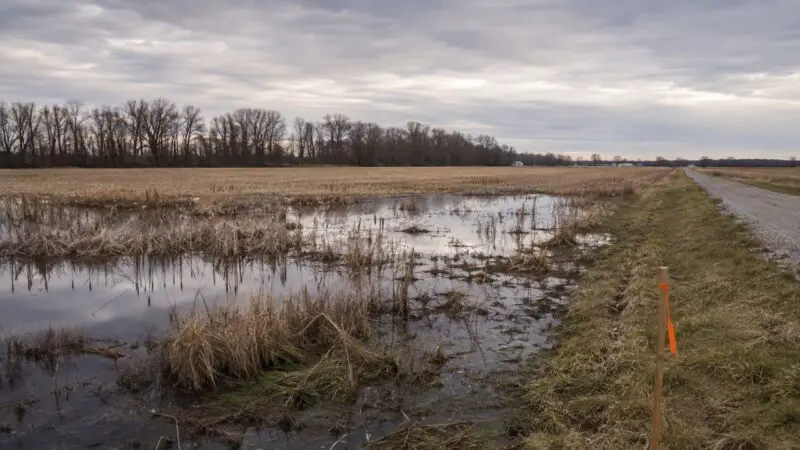
If you own land in Indiana and one corner of it stays soggy for a week after a hard rain, the rules covering what you can legally do with that ground have moved again.
This is the third time in five years. A Supreme Court decision in 2023 pulled the federal government back from a large share of Hoosier waters, and the state has been steadily trimming what it picks up in return.
So what actually changed, what stayed the same, and what does any of it mean before you call in an excavator? Here is the short version.
Key Takeaways
- Indiana has loosened wetland rules three times since 2021, and the 2026 change was by far the quietest of them.
- The 2026 law rewrote how the state environmental agency operates rather than redrawing which wetlands are protected.
- Class I wetlands need no state permit, and small Class II wetlands are often exempt from permitting too.
- The Army Corps of Engineers, not Indiana, decides whether the water on your property falls under federal rules.
- Mitigation credits still cost real money, and in two watersheds they are not currently available to buy.
- Fewer permits on paper does not mean less water sitting on your property after a storm.
What Actually Changed in 2026
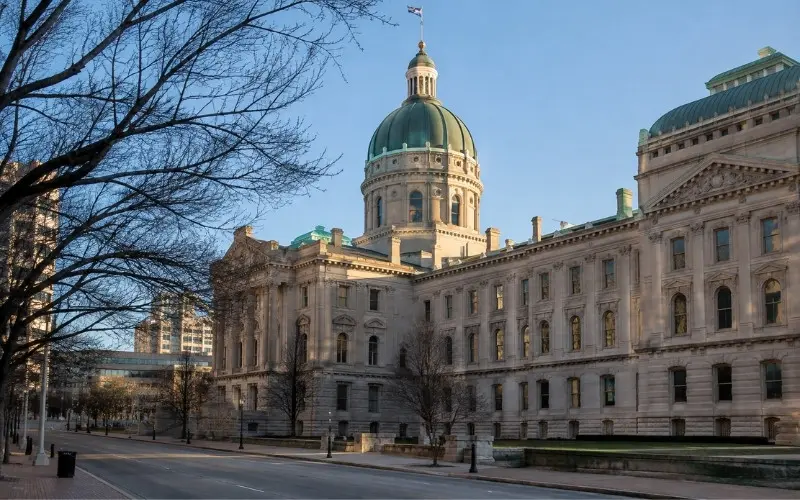
The short answer is the agency, not the map. In March 2026, Gov. Mike Braun signed Senate Enrolled Act 277, which became Public Law 135. It runs past 150 pages and reworks large sections of Title 13, the environmental portion of Indiana Code.
It does not redraw the wetland classes. What it does is convert roughly forty places where the Indiana Department of Environmental Management was told it “shall” act into places where it “may” act, and it adds a vague new test asking whether a rule is burdensome on top of Indiana’s older standard that state rules cannot be stricter than federal ones.
Reporting from Circle of Blue documented the scale of that shift during the session.
The Two Rollbacks That Came First
2021 was the loud one. Senate Enrolled Act 389 stripped state protection from Class I wetlands completely and cut back what was owed on Class II. Three years later, in February 2024, Gov. Eric Holcomb signed House Enrolled Act 1383, which moved a slice of the top tier down into the middle tier. That one took effect July 1 of the same year.
Stack all three together and the pool of ground the state will step in to protect keeps shrinking.
How Indiana Sorts Wet Ground
View this post on Instagram
Indiana still uses a three tier system, and the tier your damp acre lands in decides nearly everything that follows. Classification turns on how much wildlife and aquatic habitat the area supports and how much water it holds and releases.
That framework has been in place for about two decades and it survived the 2026 rewrite untouched, which matters because wetlands do real work in a state with some of the most polluted rivers in the country.
| Class | State permit needed first? | What it means in practice |
| Class I | No | Lost state protection in 2021. Nothing owed to the state. |
| Class II | Usually, with size exemptions | The most common tier. Small ones often slip past permitting. |
| Class III | Yes | Rare and largely undisturbed. Slowest and priciest to touch. |
The Exemptions Owners Ask About Most
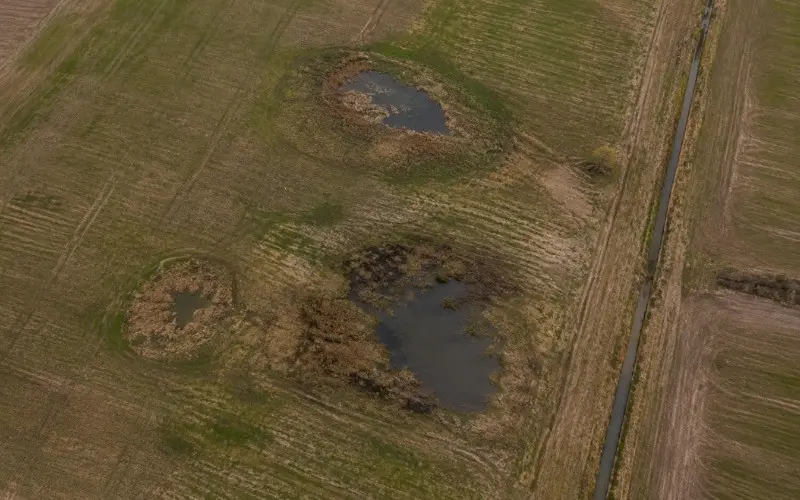
IDEM publishes the full exemptions list, and it is longer than most people expect. A few that come up constantly on residential and small commercial parcels:
- A Class II wetland of three eighths of an acre or less is generally exempt, and that rises to three fourths of an acre inside a city or town boundary.
- Wet spots that appear on a residential lawn, in a roadside ditch, in an irrigation ditch, or on working farm ground can count as incidental features.
- Fringe areas around a private pond are exempt, as are ponds you dug yourself.
One catch worth knowing: a wetland is either wholly exempt or wholly regulated. There is no splitting one down the middle.
Who Decides Whether You Even Have One
Not the state. The U.S. Army Corps of Engineers makes the call on whether your water is federal, and Indiana’s program only picks up what the Corps leaves behind. State regulators said plainly years ago that they cannot make that jurisdictional call themselves, a point covered in this look at case by case determinations.
Maps Get You Started and No Further
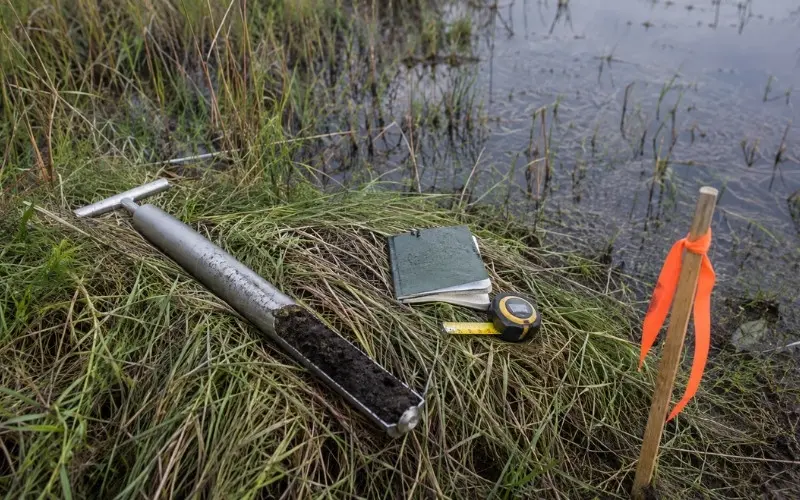
The Fish and Wildlife Service runs a national Wetlands Mapper that covers every county in the country. It is a genuinely good first look. It also carries a blunt warning: the data uses a biological definition and should not be read as showing what is regulated on your property. Only a delineation walked on foot by a qualified consultant carries weight with a permitting office.
The Mitigation Bill Nobody Mentions Early Enough
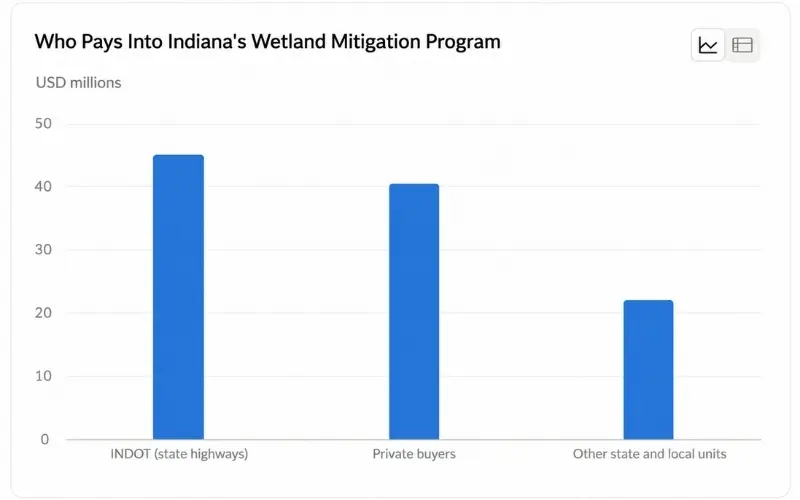
If you need a permit and you do disturb protected ground, you owe replacement. Most property owners buy credits from the state in lieu fee program instead of building a replacement themselves.
Price depends entirely on where you are.
Credits in the St. Joseph River service area run $120,000 per acre, the steepest in Indiana, and replacement ratios are usually higher than one to one.
Reporting by the Indiana Capital Chronicle laid out the numbers in detail this summer.
The Backlog Is Now a Scheduling Problem
That same reporting found the Army Corps had determined the state program was out of step with federal timing rules. The program has collected at least $109 million since 2018 and finished two projects. It also paused credit sales in two of its eleven service areas, Upper White and Whitewater East Fork White, to work through the queue.
Upper White and Whitewater East Fork White, to work through the queue. Upper White covers the Indianapolis metro area.
Demand is not slowing down either, since the wave of data center construction across the state is buying credits of its own. If your parcel sits inside a paused area, the credit you were counting on may not be purchasable on the timeline you had in mind.
If You Own Ground That Stays Wet
None of this is a reason to panic, but a few habits save people a lot of grief.
Get the delineation done before you close on a property, not after. A consultant walking the site costs a fraction of what a stop work order costs. Ask which tier each area falls into and whether any of them are already exempt.
Keep a clear record of the parcel itself. A site plan from Get A Site Plan showing where water pools, how drainage moves across the lot, and where your setbacks sit gives you something concrete to hand a consultant or a county planner, rather than a description from memory and a phone photo.
And remember that a permit is not a flood plan. Goshen found that out in February 2018 when the Elkhart River hit a record 13.2 feet and more than 300 structures took damage.
As that flood recovery story noted, most homeowner policies exclude flood damage, and only about 1% of Indiana residents and businesses carry flood insurance. Water pushed off one property tends to show up downstream on somebody else’s.
FAQ
The Bottom Line
Indiana keeps narrowing what the state will defend, and the 2026 law loosened the machinery around the program without touching the classes themselves. For a property owner the practical picture has barely moved.
What has really changed is timing. With credits paused in two watersheds and a backlog the federal government has flagged, find out what you are dealing with early and plan around a slower calendar than you would have needed a few years ago.